Hardware Validation.
Without the Complexity.
IOT TERA bridges the gap between raw microcontroller/sensor signals and high-level engineering decisions. From automated UART/I2C/SPI physical tests to 400V EV BMS diagnostics and predictive deviation analysis—engineered for engineering labs and validation test benches that demand absolute precision.
Connected Hardware.
Disconnected Insights.
You have high-precision 32-bit microcontrollers, CAN buses, and sensor arrays. But test benches still verify peripherals through manual terminal commands, record oscilloscope readings on paper, and log voltage drops on clipboards.
Manual Test Fragmentation: Engineers jump between serial monitors, multi-meters, and custom scripts with zero unified traceability.
Unmonitored Rail Droop: Intermittent supply sag under RF load goes unnoticed until catastrophic brownout in the field.
Inconsistent Quality Records: Lack of automated, tamper-proof conformance certificates slows down certification.
Continuous 8-Channel Monitoring
Streams live environmental, infrared, noise, and power rail telemetry across connected instrumentation channels.
Benchmark Differential (Δ)
Detects supply rail sag (-1.30V) and contact resistance immediately against calibrated profile envelopes.
Automated Conformance
Hardware Traceability in Seconds, Not Hours.
Generates instant ISO/IEC 17025 style conformance certificates with full 7-domain test telemetry, serial numbers, and tamper-proof execution timestamps.
From Raw Signals to
Verified Hardware.
Automated Multi-Domain Validation
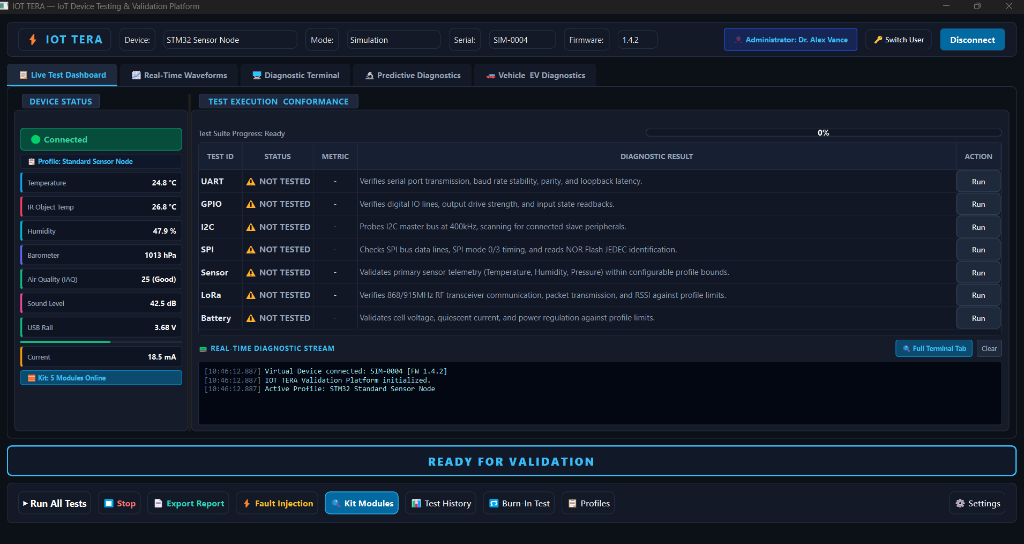
Sequentially executes UART loopback, GPIO drive strength, I2C 400kHz addressing, SPI flash JEDEC checks, sensor payloads, and LoRa RF transmissions in seconds.
Differential Deviation Matrix (Δ Tracking)
Compares physical voltages and currents against nominal tolerances (e.g. 5.00V ±5%) in real time, isolating contact resistance and power supply degradation.
Vehicle Electrical & BMS Imbalance Detection
Evaluates 400V EV traction packs, Starter Crank drop (weak voltage detection), BMS cell spread (imbalance flags), and ISO/SAE diagnostic trouble codes (DTCs).
Instant Traceable Conformance Dossier
Generates tamper-proof validation certificates ready for lab records, client handovers, and compliance audits with a single click.
>> Hardware Transport: VirtualDevice & Serial Bridge (HAL)
>> Instrumentation Bus: 5 Sub-Modules Discovered
>> UART 115200 bps Loopback: PASS [0.42 ms]
>> I2C Master 400kHz Probe (0x76): ACK CONFIRMED
>> SPI Flash JEDEC ID (0xEF4018): PASS
>> Differential Delta: Input Sag -1.30V (3.70V vs 5.00V)
>> Paper Trail & Manual Logging: ELIMINATED
Explore the 5 Core Engineering Modules
Engineered to deliver a unified, high-performance workstation for hardware validation, continuous plotting, and vehicle diagnostics.
Live Test Dashboard
Automated test execution across 7 hardware domains with precision 8-channel telemetry.
Real-Time Waveforms
Continuous telemetry plotting with channel filtering, moving averages, and live min/max metrics.
Diagnostic Terminal
Timestamped serial & bus diagnostic stream at 115200 bps with hardware audit recording.
Predictive Diagnostics
Differential Deviation Matrix comparing live measurements vs. benchmark tolerance limits.
Vehicle EV Diagnostics
Vehicle electrical HUD, 400V BMS cell spread, OBD-II trouble codes & live CAN PID stream.
Upcoming Features & Next-Gen Capabilities
We are actively expanding IOT TERA with groundbreaking AI-driven battery intelligence, next-generation automotive network standards, and autonomous anomaly root-cause diagnostics.
EV SBS (Smart Battery System) Prediction & Prognostics
Advanced prognostic algorithms predicting battery health envelopes (SOH, SOS, SOP) and isolating cell-level degradation and thermal runaway hazards long before standard BMS cutoffs trigger.
Next-Gen Automotive & Industrial Protocols
Full integration of modern automotive networking and EV charging standards for next-generation zonal vehicle architectures.
Autonomous AI Root-Cause Diagnostic Engine
Deep waveform pattern classification mapping physical signal anomalies directly to hardware-level component defects.
Hardware-in-the-Loop Fleet Telemetry Twin
Seamless synchronization of bench hardware with cloud simulation models for distributed multi-lab hardware regression sweeps.
Engineered for the Bench.
Accessible Everywhere.
Take real-time 8-channel telemetry, EV battery pack BMS diagnostics, and instant brownout sag alerts directly into the vehicle cabin, factory floor, or test track with the IOT TERA Mobile Companion.
Wireless Hardware Gateway Link
Local Wi-FiConnect directly to target embedded microcontrollers and sensor hardware with zero cloud latency. Streams 8-channel sensor telemetry at sub-10ms intervals.
Live Push Alerts & Sag Thresholds
Instant PushReceive instant push notifications when power rail droop exceeds delta limits (-1.30V brownout hazard) or when battery pack cell balance exceeds 50mV spread.
Handheld EV & BMS Diagnostics
400V Pack & DTCInspect 400V EV traction battery packs, cell voltage spread, Starter Crank voltage droop, and read/clear standard SAE/ISO OBD-II trouble codes directly inside the vehicle cabin.
QR / Barcode Hardware Pairing
DUT ScanScan device labels or PCB barcodes (e.g. SIM-0004) with your smartphone camera to instantly recall historical test runs, benchmark tolerances, and calibration logs.
To protect proprietary validation algorithms and hardware protocols, full telemetry streaming endpoints, companion builds, and API specifications are shared directly with qualified engineering partners upon consultation.
High-Performance Modular Software Architecture
A modular layer separation decouples visual presentation from test execution algorithms and physical hardware drivers.
Unified Multi-Tab Diagnostic Console
Native multi-tab UI handling Live Test Dashboard, Real-Time Waveforms, Diagnostic Terminal, Predictive Diagnostics, and Vehicle EV Diagnostics with asynchronous signal orchestration.
Supported by HIKE • Hochschule Nordhausen
IOT TERA is developed with startup guidance and incubator mentorship from HIKE (Hochschulinkubator Nordhausen) at Hochschule Nordhausen (University of Applied Sciences) in Germany. The team benefits from academic advisory, startup coaching, and regional hardware industry connections.
Let's Talk About Your Hardware Validation
We are looking for pilot partners and hardware teams interested in automated embedded testing and advanced diagnostics. Connect with the engineering team at HIKE Incubator.